视频聚合搜索 - 壹搜网为您找到"
journal-tech
"相关结果

战神3-T仔
www.iqiyi.com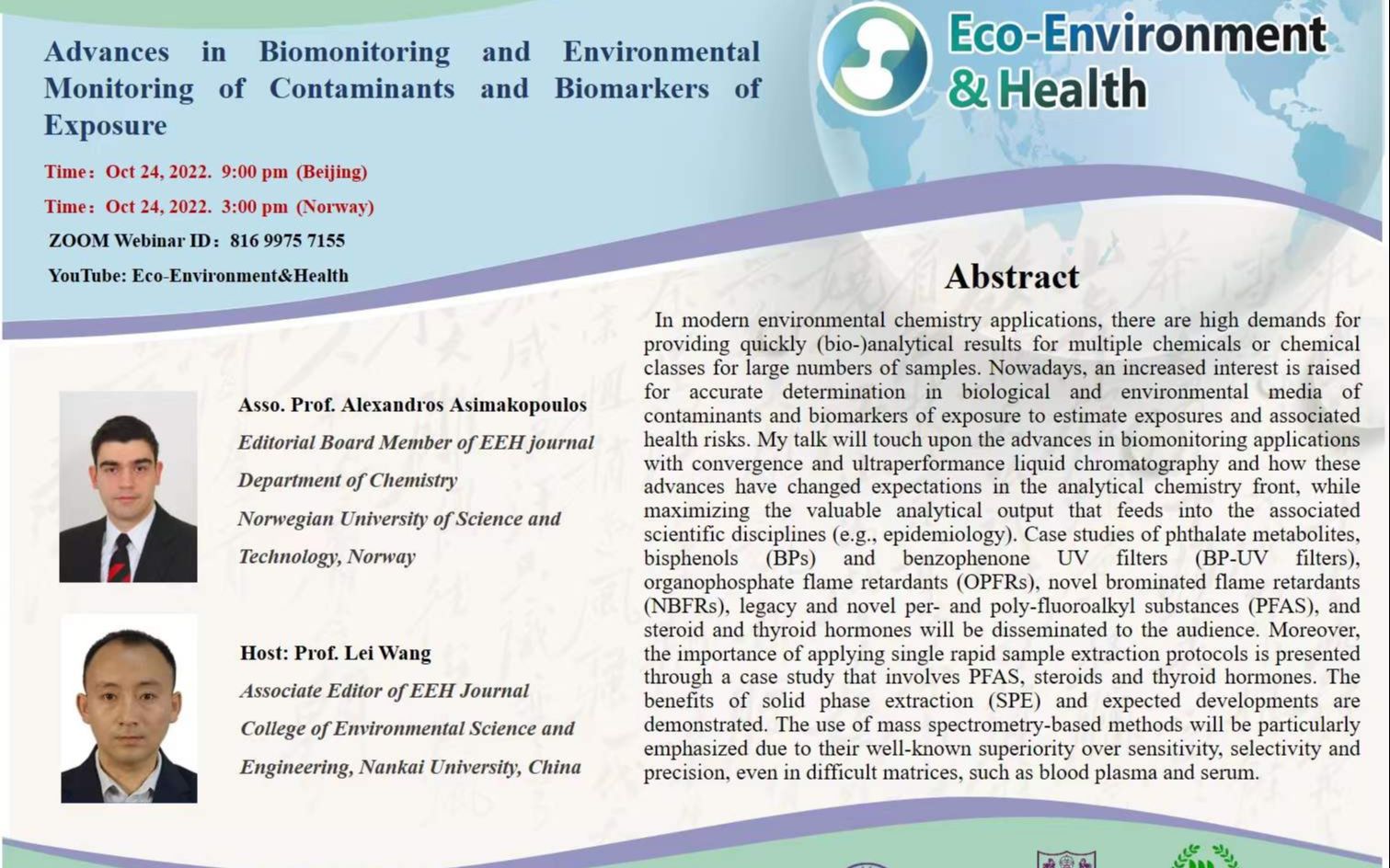
Talk@EEH第二十三讲:挪威科技大学Alexandros Asimakopoulos副教授...
Alexandros Asimakopoulos 博士是挪威科技大学化学系的副教授。他在希腊雅典国立卡波季斯特里安大学( National and Kapodistrian University of Athens)获得化学分析 - 质量控制的硕士学位和分析化学的博士学位。他是美国化学学会、环境毒理学与化学学会(SETAC)会员。Asimalopolous 博士在 Analytical Chemistry、Environment International、Environmental Science Technology、Journal of Chromatography A、Science of the Total Environment 等国际期刊发表了 80 多篇论文,获得 了3669 次引用。在 Google scholar中,他的 h指数是 30。他的研究包括开发基于 LC 和 GC、适用于 MS 或 MS/MS的有机环境污染物痕量分析方法,评估人体暴露,以及识别/开发暴露的生物标志物。 In modern environmental chemistry applications, there are high demands for providing quickly (bio-)analytical results for multiple chemicals or chemical classes for large numbers of samples. Nowadays, an increased interest is raised for accurate determination in biological and environmental media of contaminants and biomarkers of exposure to estimate exposures and associated health risks. My talk will touch upon the advances in biomonitoring applications with convergence and ultraperformance liquid chromatography and how these advances have changed expectations in the analytical chemistry front, while maximizing the valuable analytical output that feeds into the associated scientific disciplines (e.g., epidemiology). Case studies of phthalate metabolites, bisphenols (BPs) and benzophenone UV filters (BP-UV filters), organophosphate flame retardants (OPFRs), novel brominated flame retardants (NBFRs), legacy and novel per- and poly-fluoroalkyl substances (PFAS), and steroid and thyroid hormones will be disseminated to the audience. Moreover, the importance of applying single rapid sample extraction protocols is presented through a case study that involves PFAS, steroids and thyroid hormones. The benefits of solid phase extraction (SPE) and expected developments are demonstrated. The use of mass spectrometry-based methods will be particularly emphasized due to their well-known superiority over sensitivity, selectivity and precision, even in difficult matrices, such as blood plasma and serum.
www.bilibili.com


七个提高效率的宝藏科研网站!研究生必备
1.Sci-Hub www.sci-hub.ren 2.Connected papers www.connectedpapers.com 3.Researcher www.researcher-app.com 4.Deepl 翻译 www.deepl.com/translator 5.Academic Phrasebank www.phrasebank.manchester.ac.uk/ 6.Justscience https://sci.justscience.cn/ 7.EndNote 匹
www.bilibili.com
中级工程师职称论文,医学论文发表圱 中国石油大学 科技论文写作
v.youku.com